Slovak Foreign Minister's Statement on 1968 Events Sparks European Debate
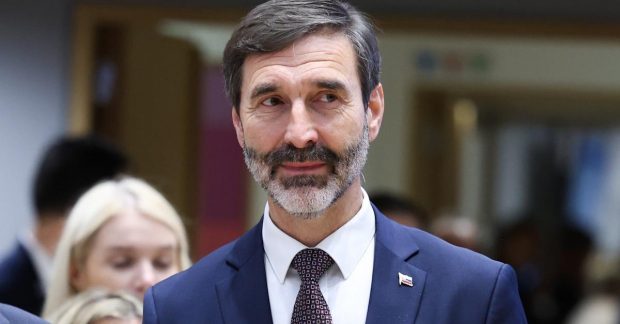
Slovak Foreign Minister Juraj Blanár claimed that Ukrainians were allegedly behind the 1968 Soviet invasion of Czechoslovakia. Opposition figures and historians quickly dismissed these historical interpretations.
 👥Society
Photo: UNIAN
Key points
- Slovak FM Juraj Blanár linked Ukrainians to the 1968 Soviet intervention in Czechoslovakia.
- Local opposition criticized the claims, pointing to Moscow's centralized rule during the Soviet era.
- Historians confirmed the Soviet military had no mono-ethnic units due to mixed conscription policies.
A fresh political debate has emerged in Europe following controversial remarks regarding historical events from over half a century ago. During a televised political talk show in Slovakia, Foreign Minister Juraj Blanár suggested that responsibility for crushing the Prague Spring in 1968 and the subsequent Soviet-led intervention in Czechoslovakia could somehow be traced back to Ukrainians. The minister, representing the party of Prime Minister Robert Fico, pointed to the birthplace of Soviet leader Leonid Brezhnev and the deployment location of the first military regiment entering the country.
Opposition Criticism and Historical Realities of the Soviet Era
These assertions immediately drew sharp criticism from the local opposition. Opposition leader Michal Šimečka expressed disbelief at the interpretation, reminding the public that the Soviet Union was a totalitarian regime where all crucial military and political decisions were centralized in Moscow's Politburo. He emphasized that the Soviet state itself served as an oppressive system for numerous nations, including Ukrainians.
Experts point out that labeling military units or leadership of that era as "Ukrainian" is factually flawed. Leonid Brezhnev was ethnically Russian, despite being born in what is now Ukraine where his parents worked at a metallurgical plant. Furthermore, the Soviet military operated under a territorial-extraterritorial draft system, meaning distinct ethnic military units did not exist, as recruits from all across the Union were mixed deliberately to prevent national consolidation.
Source UNIAN — unian.ua/world/za-pridushennyam-prazkoji-vesni-v-1968-roci-stoyali-… ↗
Read next
 🛡️Security
Power restored in Rivne region following enemy attack
After a massive blackout caused by a Russian strike on November 20, electricity has been restored to the Sarny district in the Rivne region.
 🎭Culture & Sport
Autumn Rose Care: Expert Tips for Korosten Gardeners
Experts explain why it is better to delay radical rose pruning until after the first steady frosts.
 🏛️Politics
Estonia Supports Ukraine After Strike on Russian Ship in Gulf of Finland
Estonia has expressed support for Ukraine after a strike on a Russian ship in the Gulf of Finland, calling it an act of self-defense against Russian aggression.
 🛡️Security
Rescue operation in Dymer: elderly woman pulled from the rubble
Search operations continue in the Kyiv region following a hostile drone strike on a residential building. Rescuers managed to save an 89-year-old woman, while the death t…
 🛡️Security
Russian corvette 'Merkury' reportedly damaged by Ukrainian drones in Libya
An explosion occurred on a Russian military ship in the port of Benghazi, which, according to Associated Press, may have been caused by an attack by Ukrainian maritime dr…
 🏛️Politics
Russia tests NATO defense algorithms through border provocations, expert says
Retired Ukrainian Colonel Dmytro Kashchenko stated that violating NATO airspace is a calculated Russian strategy to test the readiness of Western air defense systems.